
Malnutrition
Scaling Treatment for Acute Malnutrition
The Problem
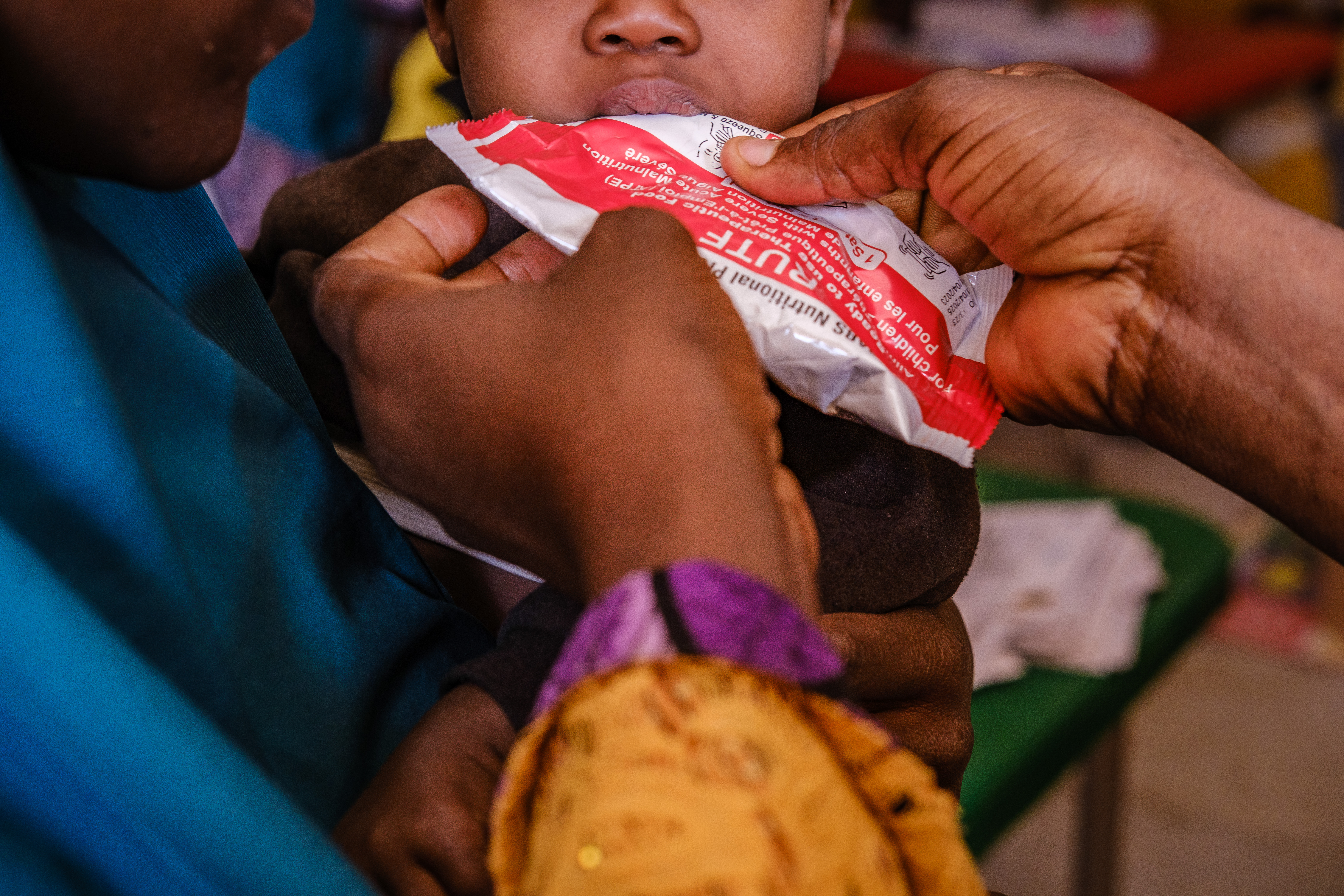
The IRC estimates that 18 million children living in humanitarian crises are suffering from acute malnutrition at any given time, despite the existence of a proven solution - a simple packet of fortified peanut butter paste. However, only 20% of acutely malnourished children are accessing this treatment, despite its known effectiveness. In addition, up to 30% of children relapse within 6 months from finishing treatment.
Why current approaches are inadequate
The current system cannot finance treatment for all children in need, and there is growing momentum for more localized, context-specific solutions, particularly in lower-risk settings. At the same time, current treatment approaches often fall short in supporting children’s long-term recovery. Many children require repeated treatment episodes due to relapse, driven by a return to chronically poor diets and frequent illness after discharge.

Our solution
1. Simplified Combined Protocols to Expand Treatment Coverage in High-Risk Areas
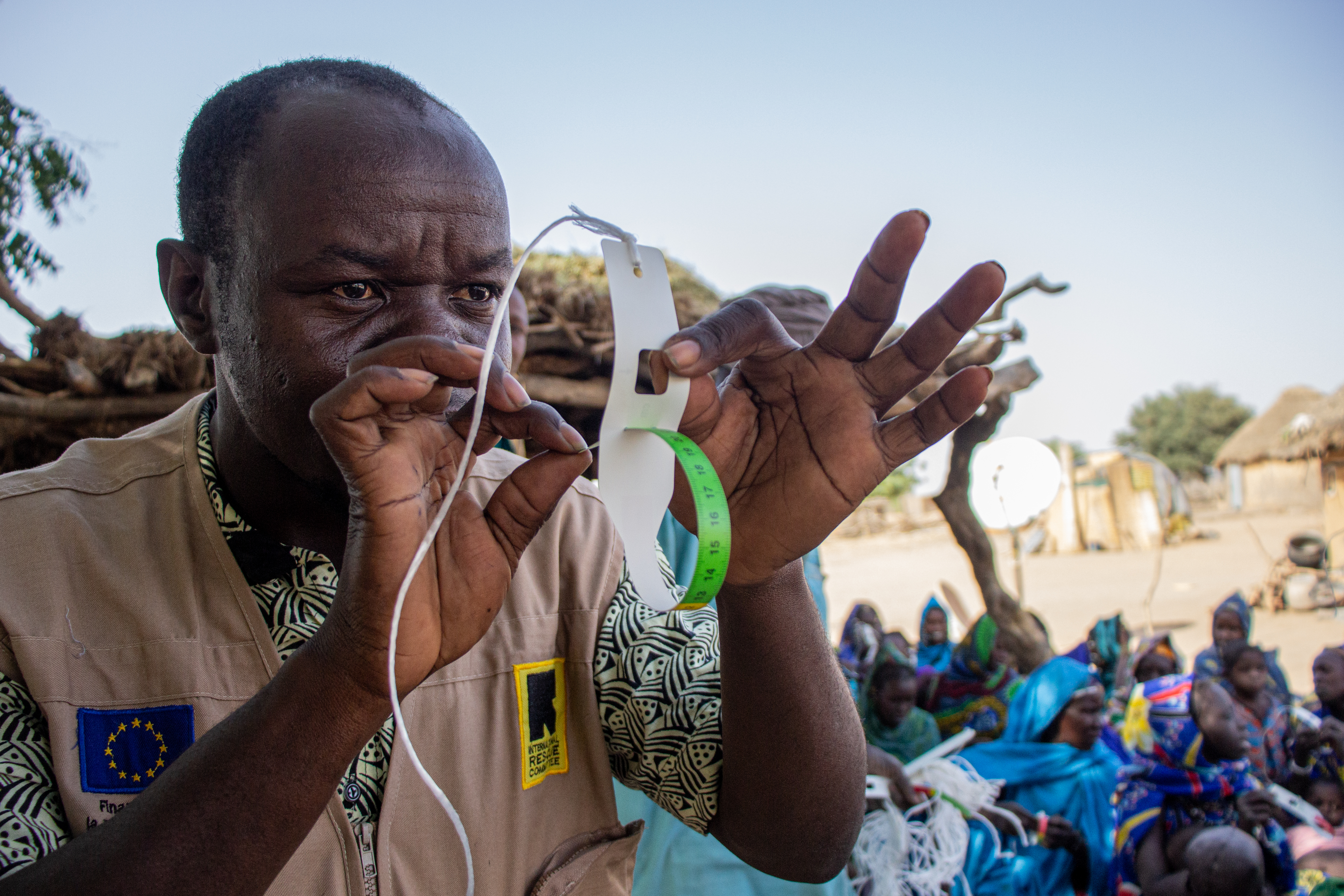
This approach uses an easy-to-follow system based on a color-coded, numbered measuring tape to diagnose malnutrition, combined with a ready-to-use therapeutic food (RUTF), a nutrient-rich peanut paste. Community Health Workers (CHWs) play a crucial role by delivering this life-saving care directly within communities. This simplified protocol is scalable, less costly, and proven effective in helping malnourished children recover. Studies show it can reduce treatment costs by around 20% per child and use 25% less nutritional product compared to traditional methods.
2. Post-Discharge Monitoring and Supplementation with SQ-LNS
After children recover from malnutrition, regular follow-up visits at health centers allow for ongoing monitoring of their health and development. During these visits, children receive high-quality nutritional supplements called Small-Quantity Lipid-based Nutrient Supplements (SQ-LNS). This ongoing support can significantly lower relapse rates and help children move beyond survival to truly thrive.
3. Sustainable Treatment Solutions for Moderate Malnutrition in Low-Risk Settings
In areas where access to specially formulated therapeutic foods is limited, this approach focuses on designing cost-effective and sustainable strategies to support children with moderate malnutrition, ensuring they receive appropriate care tailored to local contexts.
Shifting the status quo
For more than a decade, the IRC has led research into optimizing malnutrition treatment. From simplified tools for community health workers to testing streamlined treatment protocols, studying relapse prevention and documenting local approaches to treating moderate wasting, we continue to direct research toward the areas where new evidence and innovation are most needed — so treatment can be as effective and accessible as possible.
Related Projects
From Factory to Family
Redesigning malnutrition treatment: a Nigerian-made porridge that could reach far more children at less than half the cost
Explore ProjectPiloting the use of the ComPAS style protocol
Although a proven treatment for malnutrition exists, less than 1 in 5 acutely malnourished children receive it. A better system can ensure every child receives the care they need.
Explore ProjectSQ-LNS to reduce relapse post-discharge from acute malnutrition treatment
Small-quantity lipid-based nutrient supplements (SQ-LNS) hold promise for preventing relapse in an efficient and cost-effective way
Explore ProjectClosing the gap: testing treatment for severely underweight children not captured by wasting criteria
Expanding access to treatment for all children with nutritional deficits
Explore ProjectEvaluating the implementation of HeRON’s (Health Resilience of Northeast Nigeria) Transition and Sustainability Strategy
Examining the sustainability of transitioning health system strengthening program components to government partners, focusing on partners’ perspectives to identify successes and areas for improvement.
Explore ProjectCommunity Health Worker-led Treatment of Acute Malnutrition
Reaching the last mile by equipping community health workers to treat acute malnutrition in their communities
Explore Project
Latest Updates
-
Reducing relapse in children after recovery from severe acute malnutrition in Mali: ToC
The IRC partnered with Mali's Ministry of Health, local universities, and its own nutrition staff to develop a theory of change addressing why children relapse into malnutrition after treatment—identifying inadequate initial care, poor post-discharge diets, and frequent illness as key drivers. Published in Frontiers in Nutrition in 2026, this research shaped a new model that combines post-discharge health check-ups, nutrition counseling, and SQ-LNS supplementation, delivered by routine health workers.
External link
-
Applying WHO Prioritization Criteria for Moderate Wasting: Programmatic Implications
The IRC's nutrition research team finalizes a secondary analysis of our Mali pilot, examining the programmatic implications of applying WHO's prioritization criteria for moderate wasting. Analyses show that in contexts using standard Mid-Upper Arm Circumference (MUAC) tape to screen children for moderate wasting, more complex criteria are unnecessary to detect high risk: approximately 95% of children identified through MUAC already meet at least one WHO risk factor and need treatment. The evidence supports streamlined approaches for identifying moderate acute malnutrition (MAM) cases under constrained funding — and suggests that the simplified protocol is a practical, effective way to reach the most vulnerable children. The team also completes a study examining how distance affects access to care. Our distance to treatment study found that caregivers living farther from treatment sites tend to delay care, often arriving when a child is in worse condition. This highlights the need to bring treatment closer to home through community health workers
External link -
Distance From Treatment Is Associated With Poorer Admission Status and Worse Outcomes Among Acutely Malnourished Children
This secondary analysis analyzed the impact of distance from treatment sites. Our study found that children living farther from treatment had worse nutritional status at admission and poorer outcomes, even when treated. The evidence confirms that reducing travel and access barriers is critical to reducing cost and enhancing recovery.
External link -
Linear Growth During Treatment With a Simplified,Combined Protocol: Secondary Analyses of SeverelyWasted Children 6–59 Months in the ComPAS ClusterRandomized Controlled Trial
A secondary analysis of the ComPAS trial in Kenya and South Sudan compared growth outcomes in children with severe acute malnutrition (SAM) treated using a simplified protocol (fixed RUTF dose) versus the standard weight-based dosing protocol. The results showed similar linear growth, weight gain, and MUAC improvements in both groups, indicating that a lower, simplified RUTF dose can effectively support recovery in children with SAM.
External link -
Perceptions of stakeholders on the use of a simplified, combined protocol for treatment of acute malnutrition in Central African Republic
In a cross-sectional mixed-methods study conducted in two districts of the Central African Republic (CAR), most stakeholders expressed a clear preference for the simplified protocol over the standard one. They found it easier to understand, more inclusive, and effective for treating acute malnutrition. The broader admission criteria and use of mid-upper arm circumference (MUAC) measurements were especially well received.
External link -
The relationship between energy provided and growth during severe wasting treatment
A secondary analysis of the Mali pilot examined the relationship between energy intake and growth outcomes in the treatment of severe wasting, aiming to optimize nutritional interventions. The findings showed that children who received higher energy intake at the start of treatment gained weight more quickly and demonstrated greater overall growth. However, determining the healthiest and most sustainable rate of growth remains a critical question for informing treatment guidelines.
External link -
Effectiveness of acute malnutrition treatment with a simplified, combined protocol in Central African Republic: An observational cohort study
The simplified, combined protocol with a mid-upper-arm circumference (MUAC)-based ready-to-use therapeutic food (RUTF) resulted in a recovery rate that reached SPHERE standards, low length of stay and low RUTF consumption per child among all children treated.
External link -
Nutritional treatment of children 6–59 months with severely low weight-for-age z-score: a study protocol for a 3-arm randomized controlled trial
Nutritional treatment of children 6–59 months with severely low weight-for-age z-score: a study protocol for a 3-arm randomized controlled trial
External link -
Optimising ‘family MUAC’: Findings from a pilot study in Mali
Worldwide, only 20% of an estimated 50 million children afflicted by severe wasting receive life-saving treatment each year. The biggest gap to treatment coverage is identification of cases and referrals to treatment.
External link -
The effect of age rounding on weight-for-age z-scores: Evidence from Sub-Saharan Africa
Children aged 6–59 months are classified as malnourished when their weight-for-age z-score (WAZ) is lower than minus two standard deviations (< -2 SD) below the median on the 2006 World Health Organization growth standards (WHO, 2006).
External link -
No child faces: Examining the use of child images from nutrition assessments
The use of child images, particularly in the humanitarian sector, is problematic. In the worst cases, child images are used by nonprofits and charity organisations to gain sympathy and donations by showing exploitative imagery of people living in destitute conditions – referred to as ‘poverty porn’.2 More ubiquitously, pictures of identifiable minors in humanitarian contexts continue to be relied on for internal communications, fundraising campaigns, technical guidelines, articles, case studies, grey literature, and donor reports. This is despite existing guidelines and the sector espousing a central ‘Do no harm’ principle.
External link -
Cost-efficiency of a simplified protocol for wasting treatment in Mali
The treatment of wasting is currently divided into separate programmes based on severity. Uncomplicated severe wasting is treated through outpatient therapeutic feeding programmes, whereas moderate wasting is often treated through supplementary feeding programmes. While wasting is essentially a spectrum from mild to moderate to severe – with cutoffs acting as necessary proxy thresholds to designate treatment – these treatment programmes often run independently from each other with different sites, treatment days, and using different products with their own supply chains.
External link -
Post-Recovery Relapse of Children Treated with a Simplified, Combined Nutrition Treatment Protocol in Mali: A Prospective Cohort Study
The present study aimed to determine the 6-month incidence of relapse and associated factors among children who recovered from acute malnutrition (AM) following mid-upper arm circumference (MUAC)-based simplified combined treatment using the ComPAS protocol
External link