

aprendIA
aprendIA is a WhatsApp-based AI mentor for teachers and facilitators in crisis-affected contexts, where formal professional development rarely reaches and a low-end phone is often the most reliable technology available. With no new app and no new device needed, it offers long-term skill-building opportunities and immediate classroom support.
The Global Education Landscape:
- 234 million crisis-affected school-aged children around the world. Most don’t receive the education they need.
- Even when they are in school, fewer than 1 in 5 crisis-affected children can read by the end of primary school.
- In 2030, there will be a 44 million teacher deficit, including 15 million teachers needed in Sub-Saharan Africa alone.
Above statistics are from: Education Cannot Wait, State of Education for Crisis-Affected Children and Adolescents: Access and Learning Outcomes, Global Estimates 2025 Update
Educators can be the catalyst for positive change in children’s development and learning and they can mitigate long-term damages caused by conflict and displacement.
But they often lack resources, training and ongoing support needed to provide these necessary learning environments.
The Objective:
Increase learning and development outcomes for children whose education is disrupted.
Why Focus on Educators?
 Caption: A teacher in Goma, Democratic Republic of the Congo.
- We know educators are important. Research repeatedly shows quality teaching – notably teacher content knowledge, student-teacher relationships, and classroom management – to be a critically important factor influencing student learning outcomes. (Hattie 2009)
- We know the gaps in emergency contexts. One-time in-service trainings, which are a common approach due to low cost, are not effective (El Outa and Brown 2019, Ganimian and Murnane 2016). Ongoing in-person training is expensive and can be difficult to deliver in conflict and crisis settings. (Ganimian and Murnane 2016, Popova et al 2018)
- Initial evidence for digital interventions is promising. There is limited impact-focused literature on virtual or technological support to teachers in humanitarian settings. However, there is evidence that blended or distance learning interventions can be effective when designed and delivered appropriately for context (Dahya 2016, Word Bank 2018, Burns 2023). While one-way SMS-based learning can improve teacher practices and children's outcomes, two-way learning conversations (via phone or messaging) are typically more impactful. (Jordan et al, 2020)
Our Solution: aprendIA
aprendIA is a pocket-sized mentor and trainer for teachers. Combining global best teacher training pedagogies with local standards and then supercharged with a custom multi-LLM builder, aprendIA delivers reliable, classroom-ready guidance across messaging platforms such as WhatsApp.
The novelty lies in delivering curricular content through clear, simple messaging while incorporating the best IRC pedagogical practices to effectively engage and teach educators. By integrating Generative AI through OpenAI’s ChatGPT, we personalize the experience, making it responsive to the unique needs of educators, and ensure quick adaptation to new contexts for rapid deployment during acute emergencies.
We aim to reach over 1 million learners by the end of 2026.
aprendIA has the potential to make a significant impact at scale.
Here’s why:
Impact
- What we know: Ongoing teacher training focused on concrete pedagogical practices and wellbeing is one of the most effective ways to increase children's learning outcomes and social emotional wellbeing in low-income settings. (McEwan 2024, Evans and Popova 2015, Ganimian and Murnane 2016)
- What we’re learning: Initial user testing of aprendIA showed educators using the chatbot 3-4 times per week (30-40 min per session), completing 2-3 courses each. 78% found it intuitive and easy to use and think it would help them manage their classroom. Educators using aprendIA claim they are seeing increased learner engagement and their own reduced workloads.
- What is next: After integrating learnings from previous user testing, we intend to conduct implementation research on aprendIA. Results will determine if the aprendIA is showing enough promise to conduct more rigorous research.
Scale
With a central, global platform, aprendIA can quickly deploy in emergency situations with minimal adjustments. It can also expand to new contexts, adapting to different languages and the specific needs of our clients.
Acute response: We believe aprendIA has the potential to serve 11 million children facing learning disruption in acute crises alone, because of our ability to rapidly deploy from anywhere. This number represents school age children currently experiencing acute crises, have access to an adult with a mobile device, and are failing to meet learning outcomes or are not in school within the top 10 Emergency Watchlist countries.
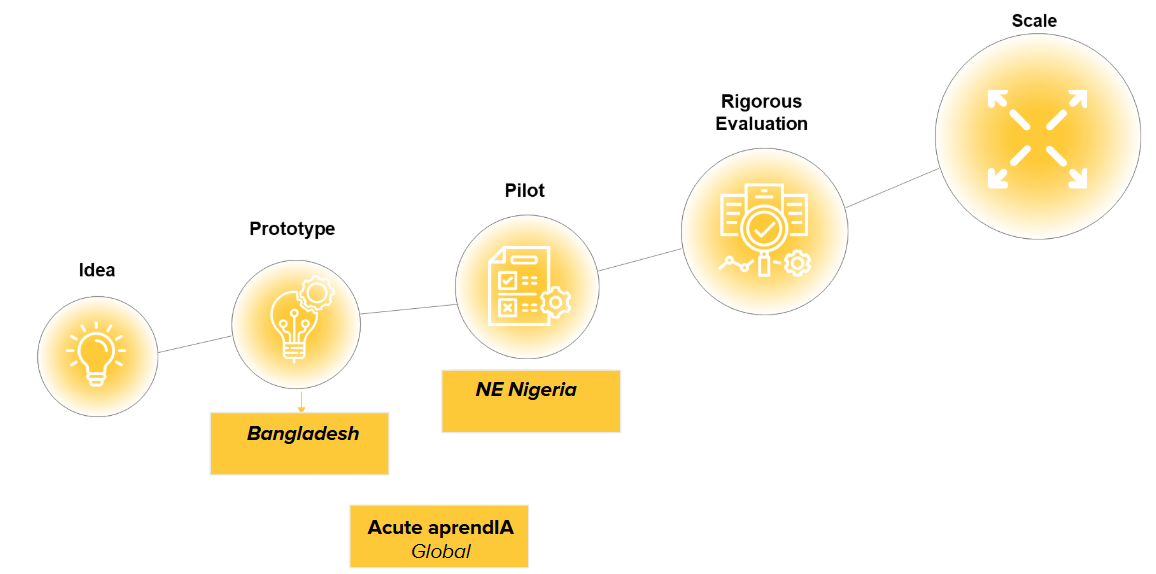
In Bangladesh, we designed and launched an early childhood education chatbot in less than four weeks. Our ambition is to reduce adaptation time to under 14 days from approval to responding to an acute crisis. Results from our AI prototypes have shown the ability to drive efficiency by reusing aprendIA’s core technology and IRC’s existing content across multiple contexts.
Responding in acute crises will rely on international NGOs and other actors to fund these emergency responses. Costs of deployment are significantly lower than standard emergency response because of existing material and digital deployment.
Scaling in individual countries: aprendIA is easily adaptable in protracted settings where it can scale through governments or other local/national scaling partners. Current estimates suggest that aprendIA will cost governments less than half of what traditional teacher training programs cost. We aim to collaborate with scaling partners to tailor aprendIA to their unique needs, integrating it into their standard practices.
To learn more, see the Nigeria case study below for details on how we are approaching this in the Borno, Adamawa and Yobe (BAY) region of Nigeria.
aprendIA Case Studies:
Education in Emergencies (EiE)
The prolonged impact of forced displacement on children demands urgent attention to education, yet less than 2% of humanitarian funding supports it. Consistent education is crucial for children’s survival, recovery and future stability. During times of crisis, teachers face limited resources, making it essential for them to have quick and easy access to the right classroom materials to support their students.
aprendIA’s EiE bot is designed for rapid deployment within two weeks, enhancing teacher capacity and wellbeing in the most urgent, crisis-affected areas. By adapting the IRC’s evidence-based Healing Classrooms program, it provides trauma recovery and psychosocial support content for young children. They can develop essential skills like basic literacy, numeracy, emotional regulation and cooperative play, preparing them for school. Delivered via WhatsApp, the Healing Classrooms content can be quickly contextualized for acute emergencies. This project explores enhanced GenAI capabilities such as Retrieval Augmented Generation (RAG), quick translations and a personal virtual assistant, in partnership with OpenAI.
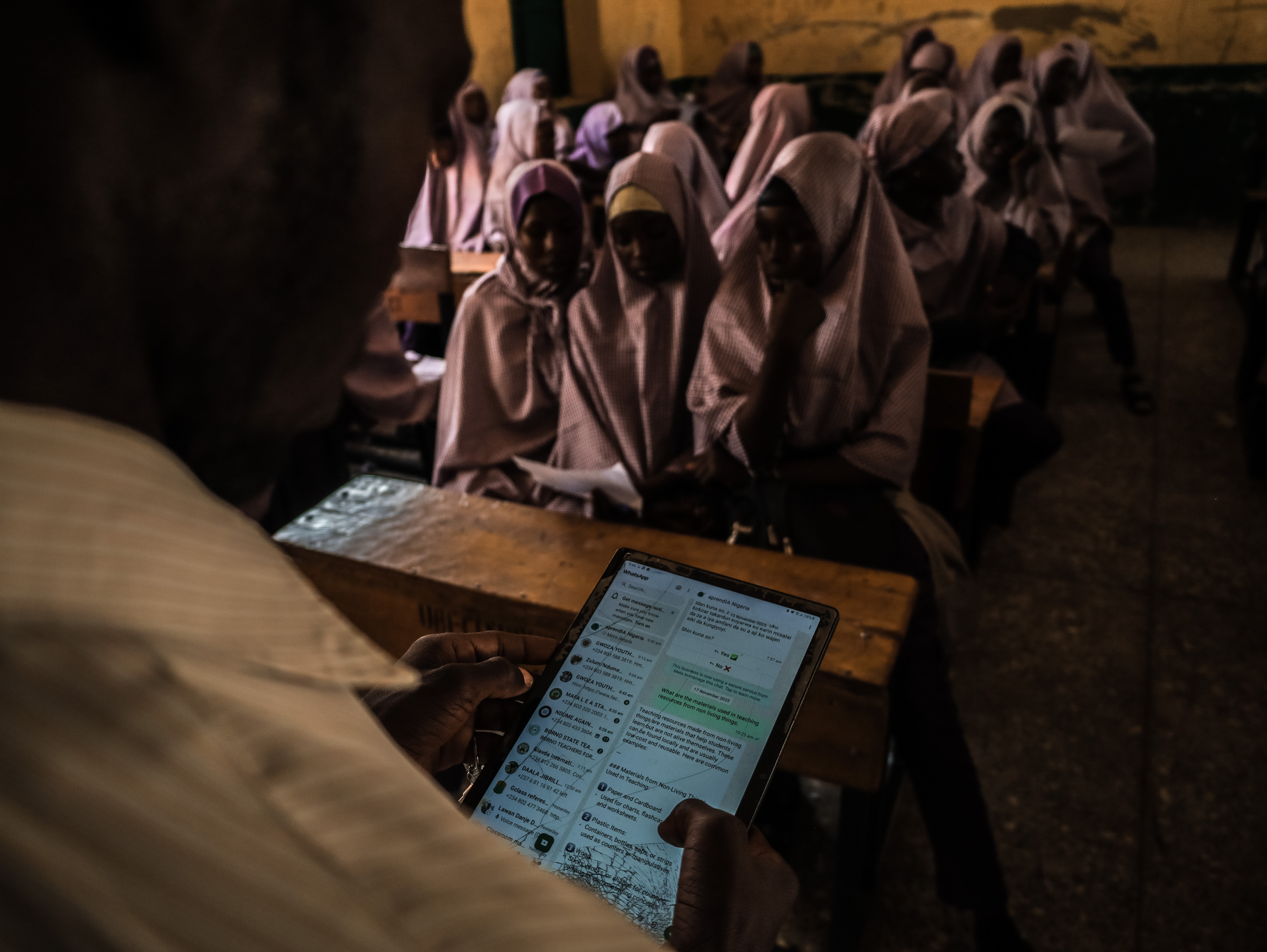
Caption: A teacher in Maiduguri, Borno State uses aprendIA to support his lesson.
1.5 million school-age children need critical education assistance with 75% completely out of school. Learning facilitators lack critical skills for managing the varied student needs and the capacity to support so many students well. This humanitarian crisis has resulted in a lack of access to resources that support an inclusive learning environment, both in formal and non-formal education, leading to poor learning outcomes. Teachers are overwhelmed by large classrooms, and they lack professional skills to deliver an enriching educational experience for the students.
Nigeria
Nigeria faces an education emergency: only 26% of Nigerian children aged 7-14 have basic reading and math skills. With 3.5 million people internally displaced, 10.2 million primary-aged children out of school, and teachers often outnumbered 1:100 in the classroom, it’s no wonder why. The scenario is even more dire in the Northeast region.
In this context, sending a child to school is necessary but not sufficient — quality learning, safe classrooms, and continuity are just as critical. aprendIA in Nigeria aims to improve teachers’ ability to create safe and supportive classrooms while also delivering quality instruction.
aprendIA Nigeria by the numbers:
- 6,050+ teachers are currently using aprendIA
- 22,000+ teachers will have access in 2026
- 137,000 teachers and facilitators by 2038
Our Nigerian team collaborates closely with local and national stakeholders both in the formal school setting and in nonformal learning centers to reach both in-school and out-of-school children. We are proud to partner with the Teachers Registration Council of Nigeria; Ministry of Education, Borno State; Adamawa State Government, Ministry of Education and Human Capital Development; Borno State Universal Basic Education Board; Adamawa State Universal Basic Education Board; and Yobe State Universal Basic Education Board.
What aprendIA’s Technology Looks Like at Scale
aprendIA offers a continuously growing library of modules that cover essential topics for educators. Drawing on the IRC’s proven pedagogical approaches, including Healing Classrooms, Learning through Play, and Teaching at the Right Level, the content is delivered in a chatbot-friendly format. This combination of instructional design and UX expertise ensures the experience is both engaging and effective. aprendIA leverages existing mobile messaging platforms to maximize accessibility, while AI-driven features personalize the learning journey, rapidly adapting content for new contexts, audiences and emergencies.

At scale, aprendIA provides ongoing support for educators in both formal and non-formal learning spaces, particularly for those without access to traditional training or who prefer self-guided learning. The platform is designed for rapid deployment, offering timely resources to maintain educational continuity during crises. We will drive efficiencies, reducing costs while maintaining high-quality content. AI enables quick adaptations, ensuring scalability without significant cost increases.
aprendIA will provide educators with ongoing support, benefiting their profession and ensuring children have access to the education they deserve.
Scan the QR code to try the demo:
To learn more visit: https://aprendia.io
Project Timeline
Reach 1 million learners.
Strengthen AI capabilities for personalized learning and increased engagement using natural language processing (NLP). Fine tune AI that enables the platform to understand user input, recognize intents, generate appropriate responses, personalize interactions, and continuously improve.
Related Links
Resources
- aprendIA
- Audio-class-system
- OpenAI x International Rescue Committee: Leveraging AI to Scale Ed-Tech in Crisis Affected Settings | International Rescue Committee (IRC)
- Tech For Refugees Announces New Grant for Welcome Connect Platform
- The International Rescue Committee named one of Fast Company’s Most Innovative Companies of 2025